NOVEMBER SOLD OUT • SHIPS DEC 12–18
Rise Nightlight
PENDANT ALTERNATIVES Wearable Friction • Updated 2026-11-13 • 5 min read

What to Do When an Aging Parent Refuses to Wear Life Alert or an Apple Watch

A medical alert necklace cannot help from inside a nightstand drawer. Compare wearable alert systems against a plug-in cellular hallway nightlight, including when a worn SOS button is still worth pushing for.

QUICK ANSWER / TL;DR

When an aging parent refuses to wear a medical alert necklace or charge an Apple Watch every night, a wearable provides zero coverage. Rise Nightlight ($0 upfront, $12/mo annual, $6 shipping) plugs into one hallway outlet with built-in US cellular, sending a morning text with nothing to wear or charge.

Side-by-side comparison

Medical Alert Wearables vs. Rise Nightlight (2026)

2026 pricing, contracts, charging schedules, and what happens when your parent leaves the device on a dresser.

Option Upfront / Activation Monthly Cost Contract & Cancellation Daily Parent Effort
Rise Nightlight Best for zero parent friction
$0 upfront ($99 value; $6 USPS Ground shipping today) $12/mo ($144/yr) or $15/mo (12-mo plan; billing starts at plug-in) 30-day trial + prepaid return; prorated life-change refund None; stays plugged into a wall outlet with nothing worn
Life Alert
$95–$248 startup fee (commonly ~$198) $49.95–$109.85+/mo (quoted by phone) Mandatory 36-month contract; no trial; strict exit rules Wear pendant 24/7 and press button (no base auto fall detection)
Medical Guardian
$0 activation; $149.95–$199.95 equipment (promos vary) ~$31.95–$49.95/mo (+$10/mo auto fall detection) 90-day minimum; up to $50 return restocking fee Wear neck/wrist unit; mobile and watch charge every 1–5 days
Bay Alarm Medical
$0 base lease; $89–$199 upfront on mobile GPS or watch $27.95–$39.95/mo (+$10/mo auto fall detection) Month-to-month; 15–30 day trial (watch fee non-refundable) Wear pendant; mobile unit charges every 60–72h, watch daily
Apple Watch (SE / Series)
$249+ SE GPS, $299+ SE Cellular, or $399+ Series; iPhone required $0/mo GPS or ~$10–$15/mo cellular (~$6.50+ select MVNOs) 14-day retail return window 18-hour battery needs daily charging + small touchscreen use
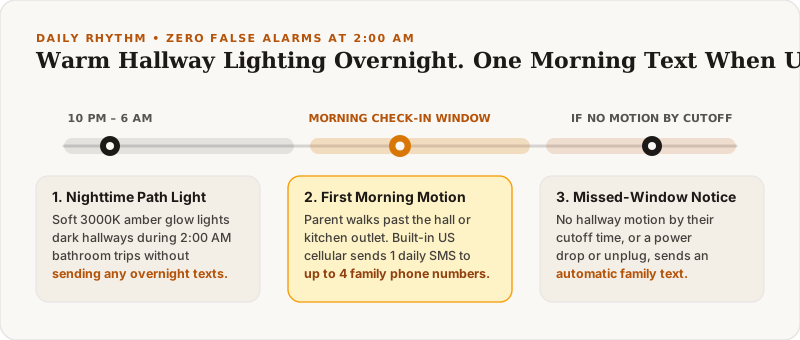
Timeline showing Rise Nightlight lighting a dark hallway at 2:00 AM without texting, sending one morning SMS when movement occurs in the wake window, and texting a late-routine alert if no movement is seen.
Rise lights overnight bathroom trips without waking your phone, then sends one morning check-in text to up to 4 family numbers.
HONEST FIT CHECK

When a Wearable Pendant or Watch Still Beats Rise

Rise confirms your parent is up and moving each morning; it never dispatches an ambulance on button press. Push for a wearable instead when:

Recent falls and willing daily pendant wear

If your parent has fallen recently, wants 24/7 voice dispatch, and agrees to wear a necklace daily, Bay Alarm Medical or Medical Guardian with +$10/mo fall detection provides active rescue.

Safety away from the house

When Mom drives, walks the neighborhood solo, or gardens across a large lot, GPS pendants like Medical Guardian MGMini or Bay Alarm SOS All-In-One 2 work outdoors where Rise cannot.

Your parent already wears an Apple Watch daily

If your parent charges an Apple Watch on a steady routine and uses ECG or Fall Detection, stick with the watch they already keep on their wrist.

Wall-mounted bathroom help buttons

If the neck cord is the only sticking point, mounted wall buttons exist from medical alert brands, though check Life Alert's 36-month contract and $95–$248 startup fees before signing.

THE COMPLIANCE GAP

Why medical necklaces stay on nightstands and watches die on chargers

Families across Minnesota tell me the same story: they paid $150 to $200 to set up a medical alert pendant, and three weeks later found it draped on a bedpost or tucked in a drawer. To an independent 80-year-old, a plastic lanyard feels like a badge announcing they are frail.

Smartwatches hit a charging wall instead. Apple Watch runs ~18 hours per charge, and medical alert watches like MGMove or Bay Alarm SOS Smartwatch also need daily charging. That leaves overnight and early-morning bathroom trips uncovered while the watch sits on its puck. Meanwhile, Life Alert locks families into a 36-month contract at $49.95–$109.85+/mo plus ~$198 startup fees.

  • Taken off for visitors: Parents slip lanyards off before friends visit and forget to put them back on.
  • Shower and early-morning gaps: Bathroom trips at 6:00 AM happen while watches sit on nightstand chargers.
  • Accidental SOS bumps: Bumping a button at the kitchen sink can send a fire truck to the driveway, making parents ditch the lanyard for good.

CLEAR EXPECTATIONS

What a hallway check-in nightlight solves (and what it does not)

When a parent refuses wearables, adult children usually default to daily morning phone calls and worry whenever a ringer is muted or Mom is out gardening. Rise closes that daily gap without a fight over necklaces or chargers. Read our Passive Check-In Sensor overview and compare multi-year expenses in the 3-year senior monitoring cost calculator.

Rise is a warm 3000K hallway nightlight with a motion sensor and built-in US cellular. It never calls 911. Instead, it texts up to 4 phones each morning when your parent walks past, and alerts your list if their wake-up window closes with no motion or if power drops. For contract details, see Rise vs. Life Alert.

BUILT INTO THE WALL

Why a plug-in nightlight works when gadgets sit in drawers

Rise looks and works like an ordinary warm nightlight: nothing to wear, charge, or press. At 2:00 AM it lights dark walks to the bathroom without texting your phone. Once their morning window opens (for example 6:00 AM to 9:30 AM), their first walk past sends one morning SMS.

No home Wi-Fi or apps are needed. Every unit ships pre-linked from Minnesota for a 60-second plug-in in an open hallway, bathroom, or kitchen outlet. If they have a dog or cat, use a counter-height kitchen or bathroom outlet so pets stay below the sensor.

NO 3-YEAR CONTRACT

30-day home trial plus our life-change guarantee

Rise ($99 value) is $0 upfront on a 12-month plan at $12/mo billed annually ($144/yr) or $15/mo monthly, and you own it after 12 months. Pay $6 USPS Ground shipping today for the December Batch (ships Dec 12–18 from Minnesota); billing waits until plug-in. If your parent moves in with family, enters assisted living, or passes away, monthly billing stops immediately and unused annual months are refunded prorated.

PARENT CONVERSATION

How to bring it up without sounding like you are policing them

Skip calling Rise a senior monitor. Frame it around your own habit: tell your parent you want to stop bugging them with morning check-in calls, and ask to plug in a warm hallway nightlight with no cameras, microphones, or lanyards that texts you once when they walk out for coffee. See full scripts in how to talk to an aging parent who refuses help.

Parents who reject pendants usually welcome softer hallway light at night and fewer check-in calls in the morning.

Zach, Founder and Engineer of Rise Nightlight in Minnesota
Written & engineered by Zach in Minnesota, USA

I built Rise so my family could know our aging parents were up each morning without indoor cameras, home Wi-Fi, or medical pendants. Every unit is assembled and pre-linked in Minnesota before shipping. About Zach & Rise • 30-day trial & life-change guarantee • See 60-second setup • Ask Zach directly

30-DAY HOME TRIAL • LIFE-CHANGE REFUND GUARANTEE

Know your parent is up each morning without changing their routine.

Rise ($99 value) is $0 upfront on a 12-month cellular plan: $12/mo billed annually ($144/yr) or $15/mo monthly, and you own the nightlight after 12 months. Pay $6 USPS Ground shipping today for the December Batch (ships Dec 12–18 from Minnesota). Billing starts only when plugged in.

Common questions

Frequently Asked Questions

Does Rise call 911 automatically if my parent falls?

No. Rise is a daily morning check-in nightlight, not an SOS dispatch button. If your parent walks past during their window, you get a confirmation text; if no motion occurs, Rise texts up to 4 contacts so you can call or send a neighbor over.

Can I add a medical alert button later if my parent's mobility changes?

Yes. Many families start with Rise while an independent parent refuses pendants, add a wearable later if fall risk grows, or use our life-change guarantee if they move into assisted living.

Why does Rise use a 12-month plan instead of charging $200 upfront?

Including the $99 cellular nightlight for $0 upfront lets families try it for $6 shipping with a 30-day home trial. After 12 months ($12/mo annual or $15/mo monthly) you own it outright, and we waive remaining months if your parent moves into care or passes away.

How does Rise handle a dog sleeping in the hallway?

Plug Rise into a counter-height kitchen or bathroom outlet so floor-level dogs and cats stay below the motion sensor.

Keep comparing

Related Caregiver Guides

View all guides ->