
NOVEMBER SOLD OUT • SHIPS DEC 12–18
Rise Nightlight
1 OUTLET VS. MULTI-ROOM SENSORS Smart Sensor Comparisons • Updated 2026-11-13 • 5 min read

1 Hallway Outlet vs. Multi-Room Senior Sensors: How Much Monitoring Is Needed?

Sticking sensors on your parent's fridge, bathroom door, and bedroom wall costs $2,700–$3,900+ over 3 years and invites pushback. Compare multi-room kits with one cellular hallway outlet.

QUICK ANSWER / TL;DR

Multi-room senior sensor kits (envoyatHome, StackCare, Caregiver Smart Solutions) install 5 to 13 wall, door, and fridge sensors for $2,721 to $3,963 over three years. For independent parents who only need morning confirmation without room-by-room tracking, Rise Nightlight uses one cellular hallway outlet for $438 over three years ($12/mo annual, $0 upfront).

Side-by-side comparison

Single-Outlet Cellular Nightlight vs. Multi-Room Kits (2026)

Hardware count, installation work, room privacy, and 3-year costs.

Feature Rise Nightlight (1 Outlet) Multi-Room Kits (envoyatHome, StackCare, Caregiver Smart)
Hardware in Home Best for zero parent friction
1 warm 3000K nightlight in a standard outlet Hub + 5 to 13 motion, door, fridge & bathroom sensors
Upfront & Monthly Cost
$0 upfront ($6 shipping); $12/mo annual ($144/yr) or $15/mo $150–$699 upfront kit + $59–$99/mo plan
3-Year Total
$438 (own nightlight after 12 months) $2,721 to $3,963 (~6× to 9× higher)
Setup & Batteries
60 seconds; pre-linked; zero batteries 1–2 hours mounting tape, pairing hub & battery swaps
Wi-Fi & App Needed
None: built-in US cellular + plain SMS Usually home Wi-Fi + smartphone dashboard app
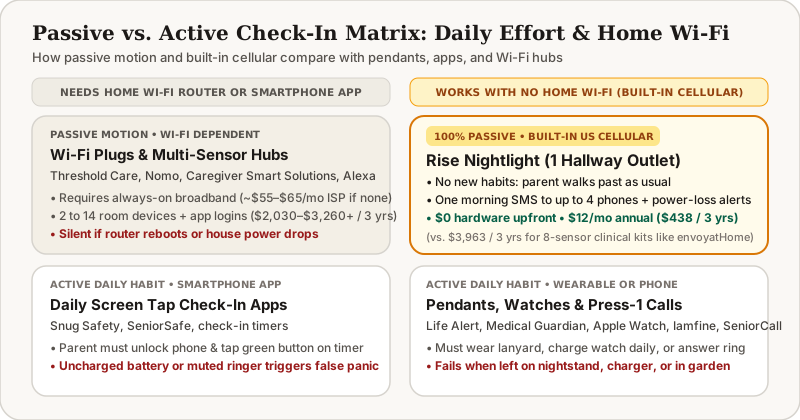
Four-quadrant matrix comparing active check-in apps and pendants against Wi-Fi sensor hubs and Rise Nightlight passive cellular hallway check-ins.
Rise combines passive daily check-ins (no buttons, charging, or wearables) with built-in US cellular (no home Wi-Fi) in a single hallway outlet.
HONEST FIT CHECK

When 8–13 Multi-Room Sensors Are Worth $2,700–$3,900+

Multi-room grids cover clinical risks that one hallway outlet skips:

Dementia meal-skipping or pill-cabinet checks

Contact tags on fridge doors and medicine drawers confirm whether a memory-impaired parent ate lunch.

Nighttime exterior-door wandering alerts

Exterior door tags alert caregivers immediately if a parent with Alzheimer's steps outside at 3:00 AM.

Nocturnal UTI bathroom spikes or room temperature

Clinical dashboards flag jumps in overnight bathroom visits or furnace failures for frail seniors.

RESPECTING INDEPENDENCE

Why healthy 80-year-olds refuse bathroom and fridge sensors

Mounting plastic pucks over a parent's bed, bathroom door, and refrigerator crosses a line for independent seniors. Nobody wants their kids checking an app chart of bathroom duration or drawer opens.

Most families only want to know Mom got out of bed and started her morning. Because daily routines pass through one shared hallway, bathroom path, or kitchen, a single outlet answers that question. See our Passive Check-In Sensor breakdown.

  • Ordinary home lighting: Guests see a warm 3000K hallway light instead of plastic wall pucks.
  • No tape or dead coin cells: Wall power eliminates drives to swap CR2032 batteries on fridge tags.
  • One SMS, no charts: Up to 4 siblings get one morning text rather than checking an app.

OUTLET STRATEGY

Picking the single best outlet in 60 seconds (even with pets)

Choose the spot your parent passes within 30 minutes of waking: the bedroom-to-bathroom hall, bathroom vanity, or kitchen coffee counter. Have dogs or cats? Use a counter-height kitchen or bathroom outlet so floor-level pets walk underneath.

Each Rise Nightlight is assembled and pre-linked in Minnesota with built-in US cellular, ready to mail straight to Mom or Dad with zero Wi-Fi passwords (see how mail-to-parent zero-setup works).

COST COMPARISON

Save $2,280 to $3,525 over 3 years with $0 hardware upfront

Over three years, envoyatHome runs $3,963 ($399 + 36 × $99/mo), StackCare runs ~$2,850 (~$150 + 36 × $75/mo), and Caregiver Smart Solutions starts at $2,721+ ($597+ + 36 × $59/mo). Compare 1-to-5-year totals in our 3-Year Senior Monitoring Cost Calculator.

Rise ($99 value) is $0 upfront on a 12-month plan at $12/mo annual ($144/yr) or $15/mo monthly ($438 over 3 years, and you own it after year one). Pay $6 USPS Ground shipping today for the December Batch (ships Dec 12–18 from Minnesota), backed by a 30-day trial and our Life-Change & Bereavement Guarantee.

Zach, Founder and Engineer of Rise Nightlight in Minnesota
Written & engineered by Zach in Minnesota, USA

I built Rise so my family could know our aging parents were up each morning without indoor cameras, home Wi-Fi, or medical pendants. Every unit is assembled and pre-linked in Minnesota before shipping. About Zach & Rise • 30-day trial & life-change guarantee • See 60-second setup • Ask Zach directly

30-DAY HOME TRIAL • LIFE-CHANGE REFUND GUARANTEE

Know your parent is up each morning without changing their routine.

Rise ($99 value) is $0 upfront on a 12-month cellular plan: $12/mo billed annually ($144/yr) or $15/mo monthly, and you own the nightlight after 12 months. Pay $6 USPS Ground shipping today for the December Batch (ships Dec 12–18 from Minnesota). Billing starts only when plugged in.

Common questions

Frequently Asked Questions

Can one Rise Nightlight cover a two-bedroom home?

Yes. Nearly everyone living alone passes one shared hallway, bathroom vanity, or kitchen counter each morning, so one bottleneck outlet confirms their daily routine.

Can we install two units in a large split-wing home?

Yes, though over 95% of single-resident homes only need one unit in the kitchen or main bathroom path.

What if power drops or someone unplugs the outlet?

Built-in US cellular lets our system spot lost wall power and send an outage text, whereas Wi-Fi plugs go silent when routers die.

How do envoyatHome and Caregiver Smart Solutions differ from Rise?

envoyatHome ($399 + $99/mo) and Caregiver Smart Solutions ($597+ + $59/mo) use 8 to 14 sensors for clinical activity dashboards; Rise uses 1 cellular nightlight ($0 upfront, $12/mo annual) for daily morning SMS check-ins.

Keep comparing

Related Caregiver Guides

View all guides ->